On Wednesday, April 29, 2026, the Toledo Bar Association (TBA) hosted area students to celebrate Law Day at the James M. Ashley and Thomas W. L. Ashley United States Courthouse in downtown Toledo. Earlier this year, area students were invited to participate in an essay writing contest focused on the American Bar Association’s (ABA) 2026 Law Day theme, "Rule of Law and the American Dream.” The winner of each division is awarded a cash prize by the Toledo Bar Association Foundation (TBAF) and published below. The nine winners and their teachers are listed below:
Division I: Grades 11 & 12
1st Place: Alexander Malloy
Whitmer Senior High School, Teacher: Matt Berman
2nd Place Saleh Awwad
Sylvania Northview High School, Teacher: Kylie Wilczynski
3rd Place Asher Hassell
Sylvania Northview High School, Teacher: Kylie Wilczynski
Division II: Grades 9 & 10
1st Place: Sarah Ali
Maumee Valley Country Day, Teacher: Daniel Cohen
2nd Place Ben Lui
Chinese Center of Toledo, Teacher: Hua Liu
3rd Place Luke Oberlin
Maumee Valley Country Day, Teacher: Daniel Cohen
Division III: Grades 7 & 8
1st Place Aurelia Cavalieri-Heller
Ottawa Hills Junior High School, Teacher: Dylan Bush
2nd Place Elizabeth Hoppenjans
Anthony Wayne Junior High School, Teacher: Kate Karchner
3rd Place Rowen Kusner
Anthony Wayne Junior High School, Teacher: Steve Varga
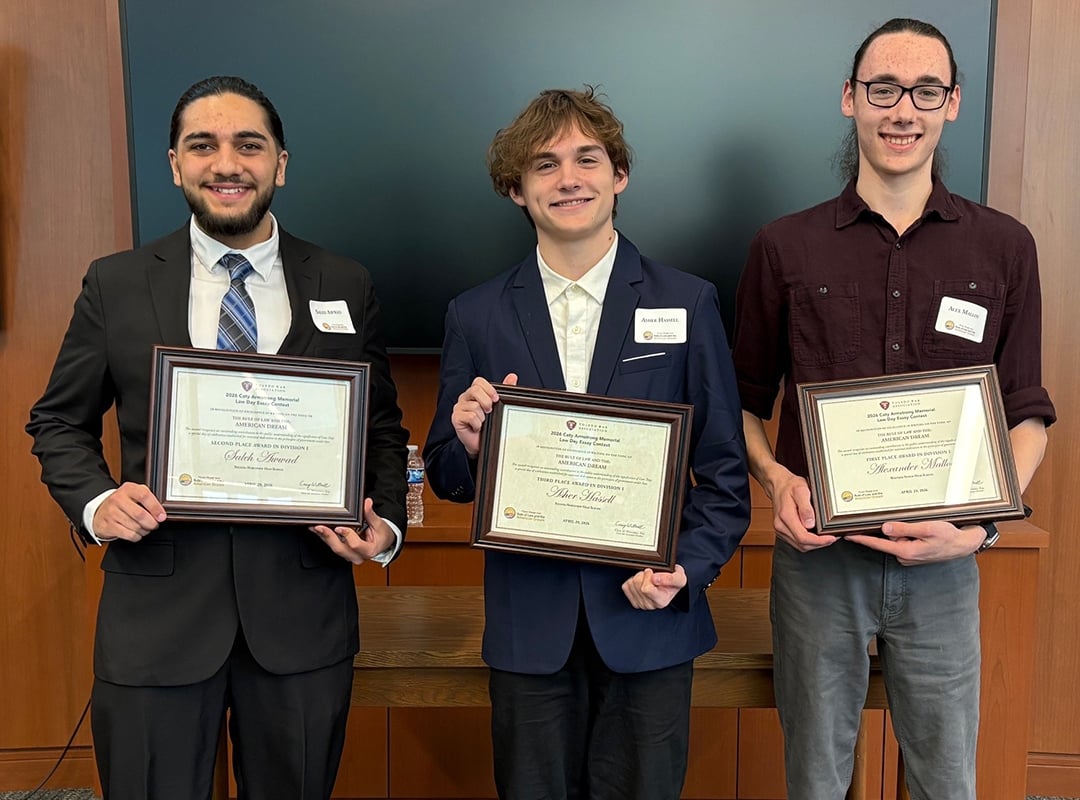
Division I Winners (pictured left to right): 2nd Place - Saleh Awwad, Sylvania Northview High School; 3rd Place - Asher Hassell, Sylvania Northview High School; 1st Place - Alexander Malloy, Whitmer Senior High School
Division II Winners (pictured left to right): 3rd Place - Luke Oberlin, Maumee Valley Country Day School; 1st Place - Sarah Ali, Maumee Valley Country Day School; (not pictured) 2nd Place - Ben Liu, Chinese Center of Toledo

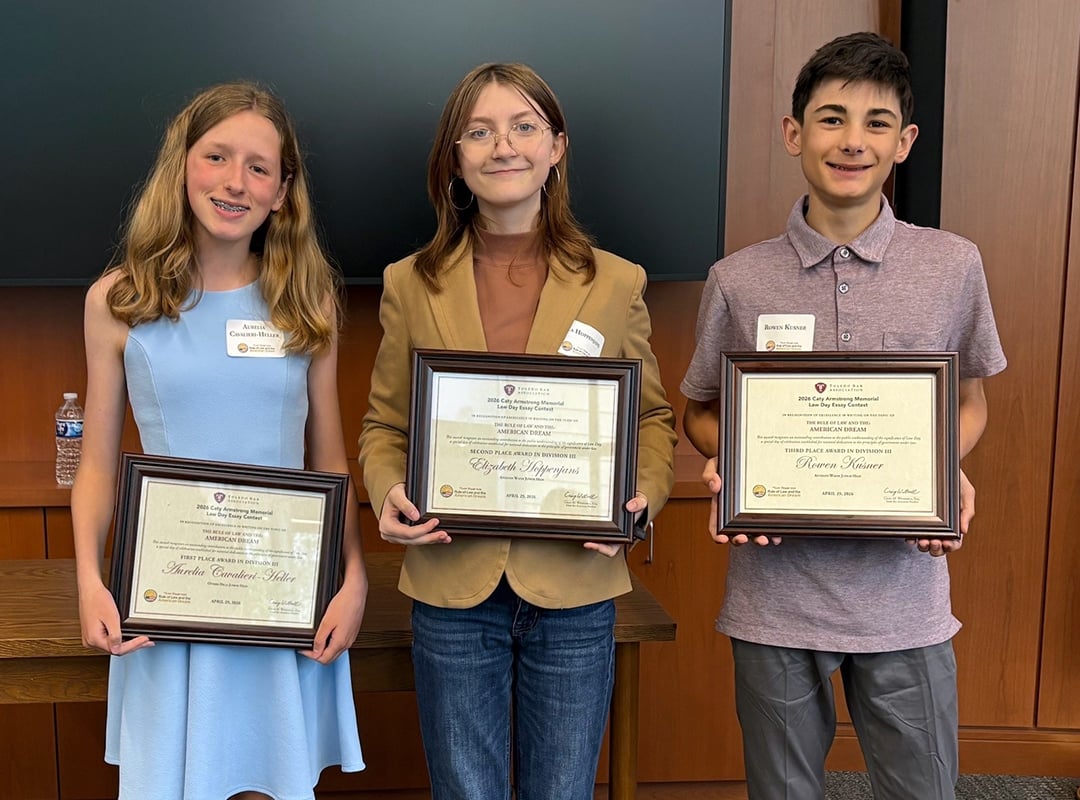
Division III Winners (pictured left to right): 1st Place - Aurelia Cavalieri-Heller, Ottawa Hills Junior High School; 2nd Place - Elizabeth Hoppenjans, Anthony Wayne Junior High School; 3rd Place - Rowen Kusner, Anthony Wayne Junior High School
Each essay was judged based upon format, clarity, style, reasoning, creativity, and overall effort. For the first round, essays were reviewed by volunteer attorneys Twila Ferguson, Martin E. Goff, Jocelyn Groll, Emily C. Samlow, and Robert J. Worthington.
The top essays were then submitted to a judge’s panel for final review to Hon. Stacy Handley Cook, Hon. Ian B. English, and Hon. Eric Allen Marks.
Hon. Jack Zouhary, U.S. District Court for the Northern District of Ohio, opened the program with remarks on the history and significance of Law Day. Hon. Darrell A. Clay, U.S. District Court for the Northern District of Ohio, presented awards to students. Following the awards presentation, Judge Clay delivered the Law Day Address.

Introduction to the Essay Theme:
From the nation's earliest days, the promise of America has been rooted in the idea that all people are equal under the law. The 2026 Law Day theme, "The Rule of Law and the American Dream," highlights how our constitutional framework protects the rights and freedoms that allow each person to pursue their own path. By ensuring that no one is above the law, our system promotes fairness, stability, and opportunity. this year, we invite students to consider how the rule of law helps turn aspirations into reality.
Essay Questions (entrants chose one):
1) How does the rule of law protect individual rights and ensure that everyone has a fair chance to pursue the American Dream?
2) What challenges threaten the rule of law today, and how might those challenges affect opportunities for future generations?
3) What responsibilities do citizens have to help uphold the rule of law, and how do those responsibilities support the American Dream?
Division I: 11th & 12th Grades, 1st Place
What challenges threaten the rule of law today, and how might those challenges affect opportunities for future generations?
Alexander Malloy, Whitmer Senior High School; Teacher: Matt Berman
Within the new administration and polarizing political climate, the rule of law (the belief that all are equal before the law) is now at risk. The system we have loved, cherished, and fought for is at risk, and we need to fight for it.
Trust in the legal system has, and always will be, strained; that is a fact no one denies. However, this has only worsened over the past couple of years. The courts of the United States of America have a constitutional duty to uphold the law, check other branches of government, and ensure that all citizens, from the worst to the best, are given the full rights, protections, and safety of the law. However, this duty has been attacked by government officials. The executive branch has pulled funding for programs originally approved by Congress, which violates the rule of law, because this means the executive branch can pick and choose which laws it wants to enforce. This was done because the Bar Association dared to defend courts and lawyers, while also expressing views on membership and actions in court, including filing a lawsuit against Trump's administration for its efforts to undermine judicial independence. This is also seen with the threats of impeachment and accusations on those in the judiciary and legal professions, like judges, because they had opinions separate from the actions of the executive branch, and penalizations on those who try to eliminate biases in our court system, which was seen in March when Trump called for the impeachment of a judge who ruled against his deportations.
But what does this mean for our future? These accusations and threats of impeachment, bias, and disinformation continue to destroy the little trust that the American people have in our legal system. This distrust and attacks strike at the very core of our courts, which is the thought that they should be able to decide verdicts only from the rule of law, and that attorneys should be able to fight for any person, free from retaliation. "The law does not protect itself; it survives because those sworn to uphold it have the courage to do so." (Kauffman, 2025) With some attorneys admitting that "Well, I've been struggling for years." (Kauffman, 2025) And with all these attacks, how do we expect it to get better?
People often say that we need to fight for our courts and the rule of law in America. But there's an issue with that statement. If the people do not trust our system, how can we expect them to fight for our courts when they already think that the system will just abandon them? This is shown by the fact that 66% of the population has had at least one legal issue in the past four years, and only half of those problems have been solved. How are we supposed to fight for courts in America when simply using our free speech or speaking out against federal officials can be met with unchecked violations?
Division II: 9th & 10th Grades, 1st Place
Threats to the Rule of Law
Sarah Ali, Maumee Valley Country Day School; Teacher: Daniel Cohen
When the law fails to restrain power, it becomes a weapon rather than a safeguard. As political philosopher Montesquieu warned, “There is no crueler tyranny than that which is perpetuated under the shield of law and in the name of justice.” His warning captures how abuse of power poses a fundamental threat to the rule of law when authority is exercised without restraint. Today, the rule of law is being directly tested by the normalization of political violence as a tool of power, executive overreach and the suppression of dissent.
A key threat to the rule of law is when a leader fails to respect constitutional limits and uses power for personal gain, such as rejecting the legitimacy of the electoral college. In How Democracies Die, Levitsky and Ziblatt highlight that refusal to accept election results and toleration of political violence threaten democracy. The January 6th insurrection illustrates how democracy is targeted when political figures reject the rule of law: rioters stormed the Capitol and assaulted police. In response, President Trump commended rioters and granted many pardons when re-elected, framing them as victims of unfair prosecution. In this example, political violence is used to enhance an individual’s power and undermine the rule of law.
Another major factor affecting the rule of law is the Executive branch’s use of power to silence dissent. Legal scholar Kim Lane Scheppele describes “authoritarian legalism” as a system in which governments maintain formal legality while hollowing out substantive rights; legal mechanisms are used to entrench power, sideline opposition, and suppress dissent, all while maintaining the appearance of legality. For example, protests throughout the United States against ICE have led to extreme brutality.
Recently, an ICU nurse was murdered for attempting to protect a woman being detained by ICE. He started filming ICE officers, and ended up being pushed to the ground and shot at least IO times. There is no justification for this kind of violence, yet ICE is given immunity to do whatever it feels is necessary in order to detain people. The suppression and murder of peop]e, to some, seems justified because ICE is an executive agency and should be permitted to weed out the abundance of illegal aliens. However, the brutality and force used by this agency completely obliterates the rights of citizens to stand up for what they believe. This is an example of authoritarianism masked by the creation of an “official” executive agency.
Although there are many challenges to the rule of law in the United States, rejecting legitimate election results, encouraging or excusing political violence, and suppressing dissent undermine the rule of law at its core. According to Fukuyama, institutional decay produces systems that exist in form but not in function (Fukuyama, 14). Unless these trends are addressed, future generations will inherit legal systems that promise fairness and equality but Jack substance. Preserving the rule of law requires not only recognizing these dangers but actively defending our core values of neutrality, clarity, and equal application for all.
Division III: 7th & 8th Grades, 1st Place
Denial of Due Process in Immigrant Deportations Threatens the Rule of Law and the Future of the American Dream
Aurelia Cavalieri-Heller, Ottawa Hills Junior High School; Teacher: Dylan Bush
One of the main challenges threatening the rule of law in the United States is the lack of due process in immigration deportation. Recently deported immigrants have been denied fair hearings, and the presidential administration has ignored judicial orders. Additionally, the law that President Trump is relying on for justification, the Alien Enemy Act of 1798, was designed to be used during wartime, so whether it is being used appropriately has caused controversy. For our nation of immigrants, this undermines the American dream.
In April President Trump said, “We’re getting them out, and a judge can’t say, ‘No, you have to have a trial.”’ This clearly violates a fundamental constitutional principle, which is that every person deserves a fair trial. His reasoning is that due process for every immigrant would take too long.1 He’s not wrong that it would be a slow process, but making sure that all people have a judicial hearing and a chance to plead their case is more important. The due process clause provides that “nor shall any state deprive any person of life, liberty, or property, without the due process of law.” The 1953 Supreme Court case of Kwong Hai Chew v. Colding held that “once an alien lawfully enters and resides in this country he becomes invested with the rights guaranteed by the Constitution to all people within our borders.” Both of these sources prove that due process applies
to both citizens and non-citizens.
A federal judge in June ruled that the deportation of 140 Venezuelan immigrants violated their due process rights. When a judge ordered the plane with the Venezuelans to be turned around and brought back to the United States, the administration ignored the order. While President Trump has invoked the Alien Enemy Act, which allows for illegal immigrants to be “apprehended, restrained, secured, and removed as alien enemies” during a “predatory incursion” or a “declared war” by any foreign government, not allowing immigrants to contest deportations before being deported makes it unclear whether the law was properly followed. Additionally, since this law is only supposed to be used during wartime or a predatory incursion, there are doubts whether the law even applies to the current situation, as it has previously only been invoked during actual war, such as the War of 1812 and World War II.
The lack of due process in immigrant deportations is threatening the rule of law in the United States and limiting opportunities for future generations. While many of the victims aren’t citizens, the fact that our president is so willing to undermine the Constitution should be a warning to everyone. In a country where a large part of the modern American dream is simply living in the United States, this challenge affects opportunities for future generations by preventing immigration to our country. Additionally, many of the children of these immigrants are U.S. citizens due to birthright citizenship, so deporting their parents denies them the chance of living the American dream even though they are already citizens.
1 ‘We cannot give everyone a trial, because to do so would take, without exaggeration, 200 years.” Broadwater, Luke, “Trump Challenges Migrants’ Due Process Rights, Undercutting Bedrock Principle.” The New York Times, April 24, 2025.
About Law Day
Law Day was established by President Eisenhower in 1958 to honor the law and is celebrated annually on or around May 1st by bar associations and the legal profession nationwide.
The essay contest for students has been an integral part of Law Day festivities for many years. This annual contest encourages youth to explore our legal system and the relationship between laws and our rights and freedoms. The Toledo Bar Association contest was named the Caty Armstrong Law Day Essay Contest after Caty’s tragic death in an automobile accident in 1993 just weeks after she was recognized as an essay contest winner.
The TBA’s Law Related School Education Committee’s mission is to develop and implement programs designed to assist all levels of our educational system in the education of students in our community about the legal system and the system of justice, including the organization of various Law Day activities and Mock Trial programs.
About the Toledo Bar Association
The Toledo Bar Association (TBA) is a voluntary professional association of lawyers in Lucas and surrounding counties. It was established in 1878 and has over 1,500 members. The mission of the TBA is to advance the highest standards of excellence for the legal profession, promote the rule of law, facilitate equal access to justice, and consciously foster a diverse and inclusive legal community, by providing unmatched collaborative opportunities, professional development and outstanding services to our members while also supporting the community at large.